
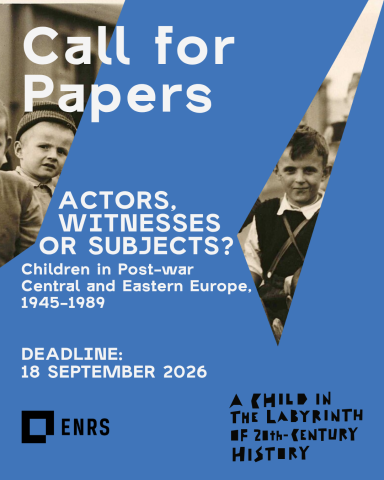
Key information
Conference: Warsaw, 19–20 November 2026
Abstract deadline: 18 September 2026
Language: English
Paper: 20 minutes
Submission: abstract of up to 350 words + short biography of up to 150 words
Contact: childreninhistory@enrs.eu
In the autumn of 1944, 12-year-old Hieronim Kowalski, wounded during a skirmish, was taken to a Soviet field hospital, where he befriended another child soldier, Volodya. They soon set off with their unit towards Berlin. When the war ended, Hieronim was a 13-year-old corporal. He returned to Poland but he did not go back to his family. He knew that after everything he had been through, there was no return to normality. He stayed in the army. In the same year, two ten year olds, Eva and Miriam Mozes from Romanian Transylvania, stepped off a train onto the old ramp at Auschwitz-Birkenau. Their family was killed almost immediately; the twins survived as guinea pigs for Dr Mengele’s criminal medical experiments, only to return after liberation to a Romania that was already changing its political system. At the same time, thousands of orphaned children – the so-called Wolfskinder – were roaming the forests of East Prussia. One of them was eight-year-old Erna Schneider, who escaped from a cattle train with her siblings and made her way to Lithuania, where for years she hid under a Lithuanian name. Although the war soon ended, the changes set in motion by the division of Europe continued to shape the lives of young people. In 1951, in Prague, the mother of 16-year-old Jana Kanska – like many other parents in countries subjected to Stalinisation – was executed following a fabricated political trial. Five years later, in June 1956, 13-year-old Romek Strzalkowski was shot dead on the streets of Poznań, one of the victims of the June uprising; in the October of the same year, 15-year-old Erika Szeles was photographed on the Budapest barricades with a rifle in her hands – a few hours later she was dead. In the decades that followed, successive generations of children and young people across Central and Eastern Europe continued to face traumatic events: the Prague Spring of 1968, martial law in Poland in 1981 and the violent unrest that accompanied the crisis and then, finally, the collapse of communist rule.
Each of these children, in their own way and in their own time, was drawn into a history that had little to do with the experience of an untroubled childhood. Yet despite this, the historiography of Central and Eastern Europe in the second half of the 20th century has largely been written without them. Children appear in it as a backdrop, as victims or as objects of social policy, but rarely as individuals with their own perspectives, strategies and voices.
Following the framework proposed by Deborah Levison, Mary Jo Maynes and Frances Vavrus,1 this conference invites scholars to examine children and young people simultaneously as subjects shaped by social processes and political discourses, as objects of ideological investment and state intervention and as agents who acted within their world negotiating, resisting and navigating official structures even under tightly constrained conditions.
The end of the Second World War left millions of children not only homeless but also suffering from long-lasting trauma. The collapse of safety and security, and the wartime experiences that accompanied this – the loss of family members, displacement, forced migration, family separation, concealment of identity, and witnessing and experiencing brutal violence, profoundly shaped the outlook and post-war development of hundreds of thousands of children. For many of those living in Central and Eastern Europe, the post-war years were not a new beginning but a struggle to find ways to survive in a reality that still offered little stability or security.
The post-war division of the world and the new political orders, especially in this part of Europe, turned the child into an object of ideological investment and political instrumentalisation: a shift also reflected in new legal frameworks. The constitutions of Eastern Bloc countries guaranteed extensive social rights for children: universal access to education, healthcare and welfare institutions that in many cases surpassed Western standards. These provisions, however, went hand in hand with the state’s claim to shape the minds of the young over and above parental authority, with compulsory membership in youth organisations, with discrimination against children from families designated as class enemies and with the political repression that children witnessed in the lives of those around them.
Guiding Questions
This conference takes the children’s own perspectives as its analytical starting point. Rather than asking what the communist state did to children, we ask what the history of the region looks like when seen through children’s eyes and what it means to recover those perspectives from the sources available to us. These are some of the questions we invite participants to engage in:
- How did children experience and make sense of a post-war reality that continued, in many respects, to remain deeply difficult?
- To what extent were they passive subjects of state power, and to what extent did they act, resist, adapt and find ways around official control?
- How far did communist regimes succeed in their ambition to shape successive generations and at what cost, both for those who internalised the project and for those who remained outside it?
- What part did parents play in shaping their children’s political attitudes?
- How did childhood under communist rule differ across the various national and regional contexts of Central and Eastern Europe, and across its distinct phases: from Stalinist terror through the post-1956 consolidation to the crises and collapse of the 1980s?
- How were children’s experiences shaped by the wider social and economic rhythms of the region, by political repression, recurring crises and the everyday constraints of shortage economies?
- What methodological challenges arise when we attempt to recover children’s voices and perspectives from archives that were largely produced by adults, about children, and for adult purposes?
- And finally a question that connects the past to the present: what do children’s experiences of life under communist rule tell us about the adults of today – the majority of the population in Central and Eastern European societies – who grew up in that environment?
- What has been carried forward, consciously or not, and what has been buried?
- Can recovering these histories help us better understand the societies we live in now?
Who Is This Conference For?
We invite scholars to engage with these questions from multiple disciplinary perspectives, bringing together the history of childhood and youth, the social and cultural history of state socialism, memory studies, including research on representations of the past in literature, film and the visual arts, and the emerging field of transgenerational trauma research. We are particularly interested in approaches that foreground children’s own voices and perspectives, drawing on ego-documents (e.g. diaries, letters and memoirs), oral history, visual sources and artefacts alongside institutional and policy histories that shaped the conditions of their lives.
Themes and Topics
We welcome proposals addressing, but not limited to, the following themes:
1. Children in the Shadow of War and Its Aftermath
• The Holocaust and mass violence: children in ghettos, camps and hiding; survivors and their post-war trajectories
• Flight, displacement and violence in the war’s immediate aftermath
• War orphans, missing and homeless children and the reconstruction of family life
• Children Born of War (CBOW): identity, stigma and post-war trajectories
• Displaced persons camps and exile communities: growing up between worlds
2. Children, Migration and Forced Displacement
• Deportations, repatriations and forced resettlements in post-war Central and Eastern Europe
• Children from families separated by war, deportation and the Iron Curtain
• Growing up in political exile, migrant communities and diaspora environments
• Eastern European children abroad: identity, belonging and the experience of displacement across continents
3. Children, Communism and Everyday Life
• State care and state control: legislation, institutions and everyday life
• Ideological formation: schools, youth organisations, children’s literature and visual culture
• Children of the ‘class enemy’: repression, discrimination and family survival strategies
• Children and young people in opposition movements, religious communities and youth subcultures
• The body, health and welfare as areas of state intervention
4. Memory and Trauma
• The intergenerational transmission of war trauma: communicative memory and silence
• Children’s retrospective accounts: oral history, diaries, letters and memoirs
• Ethics and methodological challenges in researching childhood, memory and trauma
5. Sources, Methods and Approaches
• Ego-documents and narrative sources as windows into children’s inner lives
• Objects, images and creative expression: drawings, artwork and artefacts as historical sources
• Interdisciplinary approaches to the history of childhood: between history, sociology, memory studies and trauma research
• Methodological challenges in accessing children’s perspectives across archives and disciplines
Submission Guidelines
We invite proposals for individual papers (20-minute presentations). Proposals should be submitted in English and include:
• An abstract of no more than 350 words
• A short biographical note (up to 150 words), including institutional affiliation
Please send submissions to: childreninhistory@enrs.eu by 18 September 2026.
Notifications of acceptance will be sent by 25 September 2026. The conference language is English. Selected papers will be considered for publication in the ENRS book series. The organisers offer a contribution towards travel and accommodation costs for accepted participants. Details will be provided on acceptance.
About the Project
The 2026 conference inaugurates ‘A Child in the Labyrinth of 20th Century History’ – a long-term, multi-stranded academic and educational project examining the experiences and fates of children during wars, totalitarian regimes, economic crises and forced migrations. Rooted in the history of Central and Eastern Europe, the project explores its entanglements with broader European histories. This opening stage reflects the core priorities of the ENRS: the experience of communism and its legacies in Central and Eastern Europe, and the broader effort to foster a shared understanding and collective memory of 20th-century history. As the project develops, its chronological scope will expand in successive layers, incorporating the First World War and the interwar period, the Second World War and the Holocaust, and the political and social transformations that followed in the wake of 1989. Activities dedicated to each period will continue and steadily increase over the project’s duration. The project will culminate in a travelling exhibition and a series of scholarly publications and educational resources, bringing together project findings in an accessible and enduring form.
Organisers: European Network Remembrance and Solidarity (ENRS), Federal Institute for Culture and History of the Germans in Eastern Europe (BKGE)